

Mastatest: Test Before You Tube
For producers wanting to use the most effective treatment for clinical mastitis while, at the same time, reducing their use of antibiotics, the starting point is to know as much as possible about the casual bacteria.
And the tool to do this is on-farm bacteriology, according to Agsenze’s dairy vet Matt Dobbs. The company is the UK distributor of the Mastatest system. He says a recent study shows that a significant proportion of antibiotics used, as much as 40%, will have no effect on cure rates and, in many other cases, the effectiveness of the antibiotic will depend on which strain of bacteria is at the root of the infection. The research demonstrated that unless bacteriology is carried out, many mastitis cases could be treated unnecessarily. “And these needless treatments inevitably mean productivity loss through milk withdrawal, higher treatment costs and greater total antibiotic use” says Mr. Dobbs.
Kingshay’s 2023 dairy costing focus report showed the average incidence of clinical cases at 29 cases per 100 cows. “Clinical mastitis still costs the average herd more than $13,000 per year and accounts for 9%.” Treating clinical cases is also one of the principal uses of antibiotics on dairy units.”

“Kingshay also reported a significant reduction in the use of antibiotics in dairy herds. But during the past two years the rate of the decline has plateaued.” He believes that the solution to making further progress in both reducing the incidence and cost of clinical mastitis, and further cutting the use of antibiotics on farm, is to use technologies that increase the precisions of diagnosis and treatment.
Dual objectives must be to reduce the case of mastitis, and the number of cases treated with antibiotics. “On-farm bacteriology has the capability to allow better data-based decisions to be made to reduce unnecessary and inappropriate use of antibiotics,” says Mr. Dobbs. “The effectiveness of any antibiotic depends on correctly identifying the class of bacteria causing the infection. The broadest classification of bacteria are gram-negative and gram-positive, and these strains respond differently to antibiotic treatment.
Better-Informed Dicisions
“Up to 50% of mastitis in the UK herds is caused by gram-negative bacteria, such as E. coli, or does not have any identified bacterial cause. Treating these cases with antibiotics may be unnecessary as they typically resolve without any intervention, yet in many cases antibiotics are used routinely with no benefit.”
For cows with gram-positive mastitis infection, such as Strep uberis or Staph aureus, knowing the antibiotics the particular strain is most sensitive to will improve cure rates. The herd’s vet can make a better-informed decision about the most effective antibiotic use. “The key to improving antibiotics use is rapid bacteriology to refine treatment protocols and increase effectiveness.”
Until now, bacteriology has been a time-consuming and lengthy process requiring samples to be sent away for testing, with results often back on -farm too late to allow better treatment decisions to be made for individual cattle.
Simple System
The results include the bacterial species present or confirmation of no bacteria being present, as well as its sensitivity to common antibiotics. These data are used to generate a recommended treatment plan, based on a protocol previously devised by the herd’s vet. Data gathered between July 2022 and April 2023, and presented at the British Mastitis
The results include the bacterial species present or confirmation of no bacteria being present, as well as its sensitivity to common antibiotics. These data are used to generate a recommended treatment plan, based on a protocol previously devised by the herd’s vet. Data gathered between July 2022 and April 2023, and presented at the British Mastitis Conference in June, was analyzed and the results from 1,616 clinical samples demonstrate the effectiveness of on-farm bacteriology in improving the effectiveness of antibiotic use.
In 16% of cases, no bacteria were detected, and in 24% of cases the causal bacteria were E. coli or other gram-negative strains.
“Treatment of these cases with antibiotics may not have been necessary,” explains Mr. Dobbs. “Antibiotic sensitivity testing also confirmed that in the vast majority of E. coli cases there was a low chance of the animal responding to commonly prescribed antibiotics.” For the other bacteria types there was a range of antibiotic sensitivity profiles, which has important practical implications.
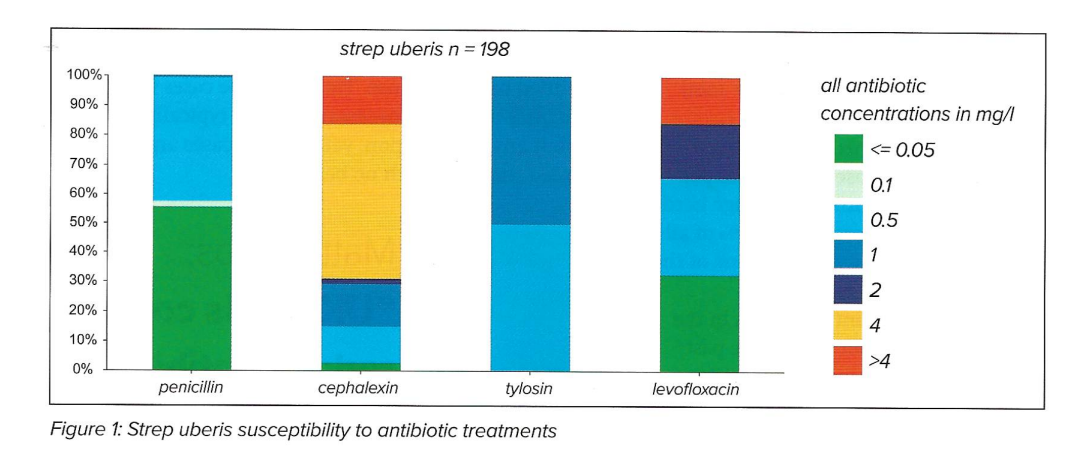
Figure 1 shows how different bacteria strains are more susceptible to different antibiotics. For each antibiotic along the vertical axis, it shows what percentage of cases had each level of sensitivity. Green indicates the percentage with a high chance that the antibiotic will be effective, blue shows a medium chance while yellow/red show a low chance of effectiveness.

In practice, even though two cases in the herd have the same bacterial cause (Strep uberis), one has a better chance of cure with benzylpencillin, but the other is more likely to be cured with cephalexin. “Having access to this information allows producers and vets to make the optimum choices. These results underline that this is no ‘one size fits all’ approach to antibiotic selection for maximum effectiveness. There were markedly different sensitivities for different Strep uberis and other Strep species,” says Mr. Dobbs. “Using a less well-targeted antibiotic will mean the cow takes longer to recover.”
Detailed Insights
Data clearly shows that bacterial identification used in conjunction with antibiotic sensitivity information gives producers and vets detailed insights into on-farm mastitis infection. And this, in turn, can provide the basis for more effective treatments.
“Based on this data, the average UK herd could reduce antibiotic use by at least 40% using Mastatest, while in other cases, more effective antibiotic selection will help reduce the consequential losses of infections,” says Mr. Dobbs.
A significant proportion of the average cost per case of $500 reported by Kingshay is made up of antibiotics and milk disposal periods. “If 40% of cases require no antibiotics, then the cost per case can be reduced while at the same time helping achieve the targets for reduced use of antibiotics on UK farms.”
The work also underlines that producers need to have antibiotic ‘options’ for treating Strep mastitis. “Choosing the most suitable option for the individual case is the best way to achieve the most effective cure rates, “ adds Mr. Dobbs.
“Timely bacterial identification combined with antibiotic sensitivity testing gives producers and vets a detailed insight into the cause of infections, allowing them to develop and implement more effective treatment protocols.”